

A Rational Look at Irrational Glass: Hunting Riflescopes
There is a strange allure to riflescopes; often technical details and real-world performance are ignored for our peculiar ideas of romancing a scope. How often have you heard "I love my xxxx scope?" Naturally, that tells nothing of what a scopes does, no more so than a meaningless "I use a xxx." So far, so what? It tells nothing, compares nothing, and often sounds like we are dating aluminum tubes rather than actually using them.
The consumer is bewildered by catalog copy, again, rightly so. Consider: “The first look through the Bushawaski riflescope is an eye-opening experience. All of our ZoomMaster scopes are: Bright. Clear. Rugged. Waterproof. Accurate. Dependable. That emerald ring tells you all you need to know!”
The only way a ring is going to tell you all you need to know is if your name is Hal Jordan and you are part of the Green Lantern Corp. It is very hard to find a scope that isn't "shockproof, weatherproof, waterproof, and fogproof." All of these terms have no specific meanings, the reason they are used so much. There are no universal standards for shockproof, of course, and scope companies don't know what kind of weather you're having.
There are some fundamental areas of agreement that hold up regardless of the name slopped onto the side of our little aluminum glass holders, fundamental reasons why a riflescope is more appropriate for field use. If we can accept what all scope manufacturers of any recognition subscribe to, then perhaps a bit of progress can be made. Consensus, of course, is far too much to be hoped for.
One piece tubes are quite superior to multi or three piece main tubes. It is hardly just the extra potential leak paths-- anytime you machine threads into an area of a tube, you weaken it as the wall thickness is reduced. Threads have tolerances and "windage." If they did not, threaded components could not be hand assembled. There is only one reason multiple piece main tubes exist in scopeland today-- they are cheaper to assemble. From a design standpoint, they are inferior in strength. Multiple threaded joints introduce tolerance stack-up, and without precise alignment of lens elements scope performance suffers in concert. Not just initially, but over time as well. This is both basic and universally embraced. Insist on a one piece main tube. One piece main tubes are now the obvious standard in riflescopes.
Fully multicoated scopes are preferred over "coated" or "fully coated." The subject of the type of lens coatings is a broad topic in itself, however the composition of some multi-chemical multi-coatings are well-known. One example is as cited in a patent, "… one particular preferred embodiment includes 70 nanometers of aluminum oxide (Al2O3), 70 nanometers of ZrO3, 225 nanometers of MgF2 and 140 nanometers of SiO2 where it is desired that the wavelength of visible light at 550 nanometers be most clearly and completely transmitted through the lens." We have come a very long way from uncoated lenses, and the single coats of magnesium fluoride that were once as good as it gets, and that's a good thing. The light we care about, of course, is the light wavelength visible to the human eye-referred to as 550 nanometers. Insist on fully multi-coated lenses if you want a bright scope. Fully multi-coated lenses are now the obvious standard in riflescopes as well: an economical Burris Fullfield II 2-7 or 3-9 riflescope has them as does a Hawke Panorama EV riflescope.
When adjusting a scope, it can be frustrating to turn reticle adjustments only to discover that what the scope does is unpredictable, as if it has a mind of its own. For that reason, friction adjustments are considered obsolete, and there is no reason to tolerate them these days.
Hunters are often horribly over-scoped. It is easy to name the super-high magnification big game hunting scopes that offer appeal-- that would be none of them. Consider that the favored military sniper scope has been the Unertl 10X fixed power. More than 12X magnification causes more problems than it is worth in many cases, and very few big game hunting applications call for more than 6X-- less, in most cases, if you happen to believe that Jack O'Connor knew what he was talking about. Over 7X or so, all the mysterious problems we love to gripe about may appear: of course field of view shrinks, the exit pupil shrinks, eye relief becomes more critical, target acquisition gets slower, and our scope may get out of focus without the benefit of the addition of the cost, weight and bulk of an adjustable objective. Internal adjustment range tends to shrink along with a large increase in potential magnification as well. That is a pile of negatives only to get a less forgiving scope, and less image quality for the dollar when all is said and done.
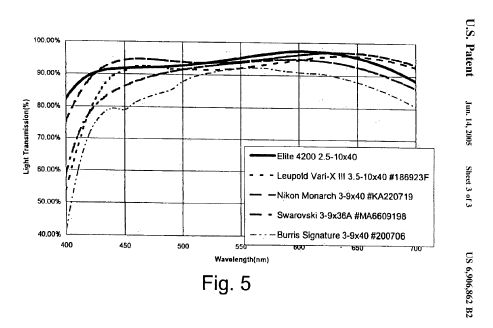
There are more important things to a riflescope than just brightness, of course-- one of the most important things a scope can do is hold its zero from shot to shot. Having a nice, crisp image of what we are missing is a blessing of limited appeal. No one I know could possibly look through a scope and tell you if it is a "91%" light transmission scope, or a "93%" light transmission scope. No manufacturer could tell you that on an individual scope, either-- the values are calculated for the most part-- not measured from your personal scope.
You don't get what you pay for, and you never have. The shrill "you get what you pay for" drivel seems to be the only answer left for those who have nothing else to offer. The snob appeal of expensive scopes, in some cases, is the only thing you are paying for. Of course we are paying for import duties, expensive advertising, expensive labor, and inefficient distribution of low volume scopes. Who else do we think does? My Panasonic three-CCD camcorder has a Leica lens; I have a Sony with a Carl Zeiss lens. Both lens are made in Japan, of course, by third parties such as Cosina. Sometimes, "Pacific Rim" is a more accurate description. Still, we all too often are blinded by the commercial magnetism of "branding," and prefer simplistic answers to complex questions. There is no "best," but it won't keep us from asking a myopic question like that. We also like to ask is something is "worth it," when obviously any notion of worth and value is a personal impression not neatly categorized. We don't get what we pay for, we never have: we get what we bother to research, investigate, and compare and define in terms of our own personal needs and applications.
Unfortunately, some of the nuances of scopes are unlikely be readily accessible at all, much less to the level of being reliably compared. Wouldn't you like to know which scopes, of any brand, have the highest return rate from that brand's line? Wouldn't you like to know what deviation from scope to scope is considered "within normal tolerances?" What level of polish is the minimum allowed on your scope? With a riflescope often being comprised of some seventy parts, it doesn't take close scrutiny to understand the opportunity for a wide spread of performance in product that comes from the same box. At one time, "labeling" was considered a damnable paint brush. It is, of course, convention in the branding and the attempted generation of pseudo-loyalty today. Choosy mothers choose "JIF."
We are actually quite fortunate today, as a two hundred dollar bill can give us build quality, precise machining, and better coatings than available to the customer at any price fifteen years ago. There is little dispute that a couple of hundred dollars can give us a lot of image quality, durability, and features just not accessible in the recent past.
Naturally, the only person you need please is yourself. Hands on comparisons, preferably not on in a well-lit retail store, will help you hone in on your own preferences. Many scopes are quite worthy of your attention. Many, many riflescopes comport to the basic, preferable attributes of one-piece tubes, metal click adjustments, fully multi-coated lenses, non-critical eye relief, edge to edge clarity, general affordability, adequate eye relief, lifetime warranties, and overall build quality.
To get the "opportunity" for quality and value, we can look at what adds to the cost of a scope without automatically adding to its build quality, durability, or usefulness. Large objectives cost more money, but rather than automatically add to quality, at the same price point they tend to detract. Extended zoom range scopes have more costly erector assemblies, so at the same price point there can only be less quality. Magnification beyond six power on a big game hunting scope is generally not needed, the reason some aficionados still prefer six power fixed power scopes: the basis is less lenses, so a lighter, theoretically brighter, less complex, theoretically more durable scope, and the only scope that has truly constant eye relief can be the result.
Most people today do prefer the versatility of a variable power scope, by a huge margin. For value in a scope, being over-magnified, over zoom-ratioed, and over-objectified means less potential quality in a scope for the same dollars, regardless of who makes it. This does not condemn larger objectives or extended zoom ratios at all. It means that in terms of per unit cost, it takes more dollars to produce a larger objective scope that compensates for the light it bends and a more complex high-ratio erector assembly. If that is what we want we can expect to pay more for the same level of overall quality, that's all, based on the actual manufacturing cost.
Copyright 2006, 2011 by Randy Wakeman. All Rights Reserved.