

Headspace:
Does not Exist in a Savage 10ML-II
The term of "headspace" as used when discussing brass cartridges has no relevance to a Savage 10ML-II, or any other muzzleloader for that matter. Like oil and water, they simply do not mix-- you cannot readily apply brass cartridge terminology to a muzzleloader when no brass cartridge exists.
Headspacing is given thorough treatment by Parker Ackley in his Handbook for Shooters & Reloaders by P. O. Ackley, Volume One. The chapter entitled "Headspace" is located on pages 151-163. As Mr. Ackley explains, there are four methods of measuring headspace on cartridges: for rimless cartridges it is from the bolt face to a point on the shoulder known as the datum line. For rimmed cases, it is the thickness of the rim or the distance from a locked bolt face to the forward edge of the seated rim. In the case of belted cartridges, it is the distance from the locked bolt face to the forward edge of the belt. For rimless pistol cartridges, where Ackley cites the .45 ACP, it is the distance from the locked bolt face to the mouth of the cartridge. None of these measuring methods are relevant to the Savage 10ML-II, or any other muzzleloader where no cartridge so much as exists to be measured. Headspace is applicable to cases; it is not and can not be applicable where no brass case exists in the first place.
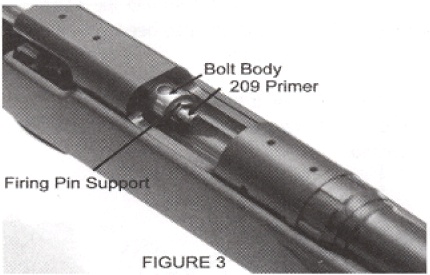
The 209 primer is located on the bolt face of the 10ML-II by the Savage's patented horseshoe metal fixture, as you can see from the illustration shown right in the owner's manual.
It is this patented bolt face idea that negates the need for plastic primer holders, discs, or full plastic jackets. It is this patented bolt face innovation that, while eliminating the need for primer related consumables, also eliminates the possibility of the primer being stuck inside the breechplug. The Savage breechplug itself is discussed, in detail, in the article titled The Magnificent Savage Breechplug, found right here: http://randywakeman.com/TheMagnificentSavageBreechplug.htm .
The 209 shotshell primer is positively located a fixed distance from the bolt of the Savage 10ML-II, a distance that cannot be modified. This distance is by design, engineered so that 100% positive ignition is obtained with the ultra-fast locktime (1.6 ms) Savage short action, keeping the center of the primer within the proper .050 inch distance considered to be optimum firing pin projection. A 209 primer cannot be seated "too far away" from the Savage bolt for anything less than 100% positive, lightning fast ignition. A light primer strike is not a possibility. The metal, horseshoe-shaped permanent primer holder on the bolt eliminates all of these concerns.
There are no universal standards for 209 primers. They vary by brand, they vary by lot, and they not only vary in size by brand, they vary in strength and in the type of primer compound used. And, they all bulge. They all bulge when used conventionally, in shotshells, of course. The difference is the press-fit and encapsulation of the primer by the shotshell hull that mitigates and limits the stretch. Only so much quality goes into a shotshell primer that costs a cent to make, so it is just as can be expected. The depriming stations on my MEC 9000G progressive shotshell presses are not "optional" stations at all-I sure can't flick a spent primer out of a hull with my fingernail.
So, there is no headspace from bolt face on a Savage 10ML-II to any part of a primer; it is fixed by bolt design. There is also no headspace dimension on the breechplug. The breechplug is precisely positioned at the factory so the bolt can guide a Winchester W209 primer into it, and the bolt closes properly. The breechplug is designed with a positive stop; it is prevented by geometry from being "screwed in too far" unlike some other muzzleloaders. As one of the many additional safety features inherent in the Savage design, the primered bolt cannot be closed at all if the breechplug is even slightly out of battery, much less fired.
All this is addressed at the factory with W209 primers. Primers that vary widely in size by brand and by lot number of course cannot be all addressed. None of these considerations have anything remotely to do with brass cartridge headspace by any of the four methods of convention. Original patent holder, Henry C. Ball, comments, "The only thing that talk of muzzleloading head spacing shows is that perhaps too much excess space exists inside of theirs." Headspacing and caseless muzzleloading applications do not jibe.
209 shotshell primers bulge and puff when fired; all of them do. The design of the Savage 10ML-II does not fight this well-known fact: it instead takes advantage of it. When the primer puffs, it instantly creates a seal-- a seal so effective in the Savage application that the 10ML-II bolt never needs disassembly for cleaning. That is the unique "internally sealed action" that only the Savage 10ML-II has been able to brag of for many years by now.
If the occasional primer sticks to the end of the bolt, Savage has you covered. Close the bolt and pull the trigger on an empty 10ML-II . . . the firing pin instantly frees the primer. The "best way" to stick a primer is to fire it into an unloaded Savage. There is no substantial backpressure generated as compared to live firing. The back pressure generated from live firing a Savage 10ML-II is just enough to naturally free the primer.
I'm currently using W209 Winchester primers or Federal 209A's. The Federals run a bit larger. I've not stuck a primer in recent memory; they tend to fall right off the bolt between shots.
The very best primer for you is a matter of a small amount of trial and error. Interior ballistics change contingent on powder, projectile, sabot, and primer. Change one of these, you may affect them all. The primers themselves vary based on face geometry, how they indent, and the resultant tackiness or lubricity after firing. Winchester W209's work superbly as reported by tens of thousands of Savage enthusiasts around the country, but you personally might have the best results with CCI, Remington, or Federals. All it takes is a little trial and error, and then you'll know what your gun and your load tells you is the smoothest: you will have found your "Penultimate Primer."