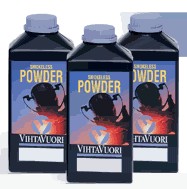
Is Vihtavuori N120 is the Very Best Savage 10ML-II Powder?
In my opinion, yes! I've been handloading for a very long time, and like many people-- I go about the load selection process in a very simple way: I test most every suitable powder available, and find the combination that suits me and my weapons the best. It is time-consuming, and shotshell reloading and Savage 10ML-II load work are kindred spirits. Both use 209 primers, give you a variety of plastic wads to choose from (sabots of course in the Savage), and a variety of projectiles as well. Pattern quality is foremost in shotgun land, and naturally accuracy takes precedence in muzzleloading. Ancillary considerations are fouling levels (gas guns don't like it), felt recoil, and so forth. It has all boiled down to Alliant Green Dot (thanks to Don Zutz) for most 12 ga. loads, and Winchester Super-Field for 12 ga. pheasant loads and most 20 ga. loads for cumulative reasons relatively unimportant here.
When it comes to the 10ML-II, the current Savage recommended powders of Accurate Arms 5744 and Vihtavuori N110 are hard to beat-- with SR4759 a notch back in my view due to the lot-to-lot inconsistency apparent in many IMR powders. Savage Arms recommends bullet weights from only 250 to 300 grains; to deviate from that would require different propellant parameters.
The fact that the 10ML-II is best designed, best made, and best performing muzzleloader available today is hardly in dispute; only those who have settled for less could possibly make that assumption. The Savage 10ML-II is the real deal is rediscovered by muzzleloading enthusiasts all over again, year after year. It was the twinkle in Savage Sports Corporation Chairman & CEO Ronald Coburn that made Henry Ball's dream a reality at the 1999 SHOT Show. As such, Savage muzzleloading is already nearing its seventh anniversary. Many are surprised that this rifle has been established for this long; and this of course does not count the many years of development the preceded the Savage application of the most modern production materials, methods, tolerances, and quality control to achieve the current Accu-Triggered 10ML-II models that have inspired such a devout following among hunters across the country.
Propellant selection is important; in fact one of the greatest errors in judgment that can be made by a new owner is to ignore the current Savage recommended powders, forsaking them for just what happens to be lying around. Every competent reloader knows the adage, "when in doubt, throw it out." Good advice for any muzzleloader that is, by definition, a handloader in the field.
I've tested pounds of most all the historical Henry Ball and son propellants, and many powders on behalf of powder companies that are not yet on the market. I've been reticent to lobby for or promote powder changes, as most of the frivolous powder discussions offer no real-world hunting benefit over the three Savage recommended powders. In fact, the match of Vihtavuori N110 and 250 grain saboted projectiles just couldn't be much better. For volumetric measuring, Accurate Arms 5744 has yet to be equaled, and has been my preferred propellant for some time due to this, availability, packaging, and other factors.
For 300 grain projectiles only, though, one powder has emerged as a superior propellant above the rest-- that being Vihtavuori N120. It took me a while to become completely convinced of this for a couple of reasons. The preexisting data put out by amateurish sources was horribly flawed; something to be expected if the majority of the shooting is done by keyboard instead of with a Savage 10ML-II. Also, after my own testing proved far more promising than I could have possibly imagined, DOT paperwork made N120 unavailable for a time-and fully load workup was aborted. The availability problem has been resolved for good; anyone who wants this powder can either have their dealer bring it in for them, or order themselves from Graf & Sons, or even Vihtavuori direct. As cheap as the 10ML-II is to shoot, and with the cost per mile of operating a vehicle these days-- the Haz-Mat fee quickly becomes a non-issue for those that want to get the most out of their 10ML-II.
The Savage 10ML-II was designed around 300 grain projectiles, its 1:24 rate of twist barrel stabilizes them where slower twist-rate frontloaders cannot, and the wounding capability is greater with a 300 grain bullet vs. its lighter sisters. Whether you prefer a Barnes MZ-Expander, a Sierra .4515 JSP Sportsmaster, a Barnes Original, or a .452 Hornady XTP-the 300 grain bullet when launched at similar or even slower velocities yields less velocity erosion, less vertical drop, less wind drift, and better penetration. It strikes your game animal with more energy at all ranges, the difference becoming more remarkable as ranges increase. All always, saboted projectiles only are allowed in the Savage when used with the smokeless powder it has been specifically designed for, and utilizes so superbly.
The name of the game for consistent performance is protecting the item in the system that gets the most abuse; that being the polyethylene sabot. The best sabots, such as those manufactured by MMP, must necessarily be soft and pliable enough to be easily loaded by hand from the muzzle-a severe restriction in the durometer of the material that can be used. It is the load from the muzzle containment of sabot strength that means the Savage, like all muzzleloaders, is a relatively short range weapon that must necessarily use relatively large diameter, heavy bullets than just won't fly all that flat. The accuracy of the 10ML-II and its ability to handle 300 grain saboted projectiles allows it to harvest game quicker and more humanely than other muzzleloaders at all ranges-- however, in no way can the 10ML-II shoot as flat as a 7mm RemMag, .22-250, or a .300 WinMag centerfire. That type of comparison has no basis.
The 10ML-II is indeed the most powerful muzzleloader there is, second to none in that department. However, just like the very best muzzleloaders-- the ballistics remain comparable to a blackpowder cartridge, the .45-70 Government. It well should be, as we use the same or similar bullets.
There are reasons for everything, so allow me to list the reasons that find Vihtavuori N120 as the best 300 gr. saboted propellant there is. In doing so, I'll compare it to a few other powders as well.
Heat of Explosion is a value not often looked at, but a cooler burning powder automatically inflicts less punishment on our sabots and ventliners alike. The Heat of Explosion value for Vihtavuori N120 is about 22% less than Accurate Arms 5744; hardly a trivial amount. It is lower than the faster burning N110, and even lower than the slower burning N130. Surprisingly, it is lower than a wide variety of slow-burning powders-inclusive of Reloder 7, Reloader 10x, Accurate Arms 2015, IMR 4198, and Hodgdon H322. All of these powders would require heavier charges than N120 to achieve the same performance, and that means unnecessary cost and recoil. N120 offers a more complete powder burn as well in the 10ML-II which translates to less unburnt powder fouling. In fact, the percentage of propellant burnt exceeds the efficiency of 5744. So, it does all this, yet gives a significant velocity increase over 5744 with a cooler burn, a more complete burn, less peak pressure, less ventliner erosion, less fouling, and less sabot damage. That is a compendium of cumulative benefits that no other propellant I've found can approach.
For reference, lets take a look at the interior ballistics prediction for 55 gr. of N120 using a 300 gr. saboted projectile:
With peak pressure in the calculated sub-25,000 area, it isn't hard to see why a load like this is easy on your sabot, vent-liner, and barrel. It still gives us an approximately 90% propellant burn inside the barrel, and if you can hit it with this load, you can eat it. Average actual chronographed velocity for the 55 gr. load is 2187 fps. The accuracy I've experienced has been phenomenal, in this case stepping up to a max. charge of 60 grains:
This was with the Barnes Original 300 gr. Spitzer Soft Point, in the MMP Orange .50-.458 sabot.
If you'd like a wonderfully soft shooting load that mirrors or exceeds the exterior ballistics of 5744, 50 grains by weight of N120 is all you need. For all full powder hunting load, I've settled on 57 grains which coincides with my day-at-the-range recoil tolerance. Those who actually enjoy recoil can go up to 60 grains by weight (as above, but that load starts to talk to you)-- but any more than that just gives you recoil without much benefit, and starts to destroy what we have sought to achieve in the first place-- minimal ventliner wear, and most importantly, no danger of sabot destruction or accuracy degradation when using current formulation MMP sabots. 52 - 57 grains has proven to be the ideal min. max. range, contingent on your personal needs and preferences.
Vihtavuori N120 is the best I've found with 300 gr. bullets; it responds nicely to .033" ventliners and Federal 209A primers which I use whenever possible, but works quite proficiently with Winchester 209s and factory ventliners also. Vihtavuori N120 is simply a superb 10ML-II powder, the very best I know of.
Now that this is out of the way, it is time to continue with what the Savage 10ML-II was born to do: quickly, cleanly, ethically take game with one shot at close range-- like no other muzzleloader can, remaining true to the Savage muzzleloading heritage of performance and accuracy that Henry Ball and Ronald Coburn gave us nearly seven years ago.
PS
The Savage preferred powders as listed in the current manual are N110, 5744, and SR4759. Savage specifically recommends saboted .452 Hornady XTPs and SST's, 250 or 300 grain. Savage does not recommend sabots with smokeless over 300 grains in weight. In a few instances (Maryland) the regs dictate a minimum of 60 grains of powder. You cannot use 60 grains of the three Savage preferred powders, that will quickly destroy sabots and is well over the limit. N120 gets you there, however-- quite nicely.
© October, 2005 by Randy Wakeman
Email: [email protected]