Antelope Anticipation
Prior to an upcoming pronghorn hunt, the 10ML-II was confirmed at both 102 yards and at 220 yards. The specific load selected was 57.1 grains N120 pushing a .458 Barnes Original 300 grain Spitzer Soft-point, housed in the current formulation orange .50 / .458 MMP sabot. A Winchester 209 primer, a .033 RW ventliner completes the array, topped off with a Bushnell Elite 3200 4 -12 x 40mm scope with a ballistic plex reticle. Muzzle velocity is approx. 2250 fps.
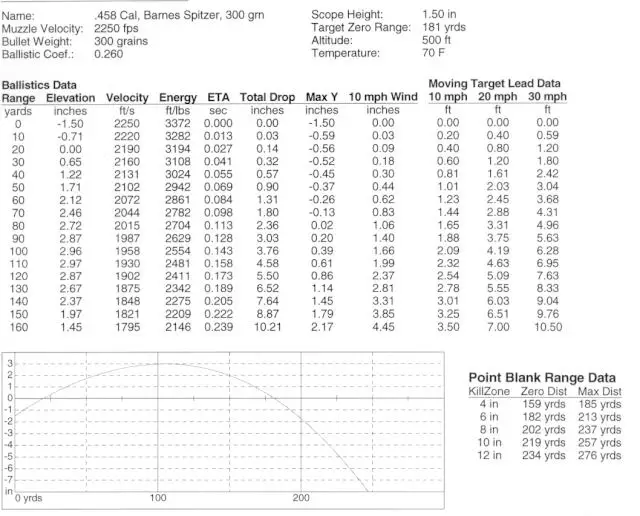
The "Plainfield, IL" BC at this velocity and at 220 yard range is an actual .260. The specifics are illustrated in the illustration, as most illustrations aspire to do:
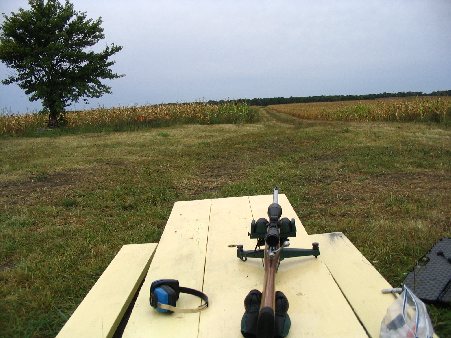
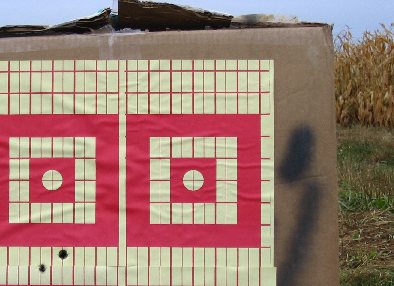
Late last evening, preliminary sight-in was confirmed, but it was a bit too windy to do any reliable long range work. This morning, by hopping out of the sack at 3:30 AM, we were able to beat the wind-- and I picked up my Dad on the way down to field. With dead calm as the sun rose, it was wasy to confirm this load with three consecutive sub 1/2 MOA groups, 3 inchs directly over the bull @ 102 yards. Then, time to set up for some 220 yard work.
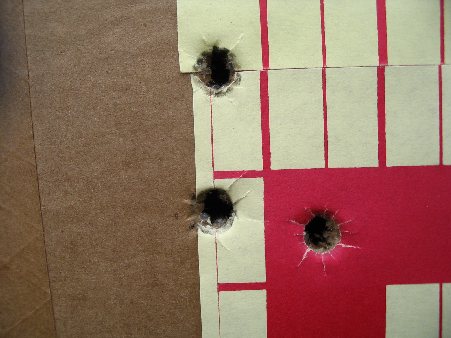
With still no wind to deal with, the first two shots at 220 yards fell about 1 1/8 in.CTC from each other, right at 4" low.
Ballistics @ 220 yards, 500 ft. above sea level, are about -3.97 in., 1643 fps, 1797 fpe, ETA of .344 seconds.
At 5000 feet above sea level, a bit more representative of the hunt:
-3.26 in., 1727 fps, 1986 fpe, ETA .335 seconds @ 220 yards.
My windmeter picked up light, gusty winds from the North, from 4.2 to 6.4 mph-- a direct cross. The next three shots resulted in a 1-3/4 in. CTC three shot 220 yard group, blown slightly to the left.
Satisfied that those shots would have been five dead pronghorn, and with the first cross-hatch of the ballistic reticle meaning 3 inches @ 100 yards, it should be straight through the body out to 220 yards, line #1 of the ballistic reticle good-to-go to 275 yards. It likely will shoot a bit flatter than that due to the area 44 elevation outside of Laramie, WY, but that will naturally be confirmed on location prior to hitting the field.
The second line of the reticle keeps things in the vitals out to 300 yards, with 1560 fps, 1621 fpe terminal, .482 sec. ETA. I'm advised by Barnes that the Barnes Original Spitzer Soft Point needs more velocity for reliable expansion than their MZ-Expanders; in this case about 1400 fps. I believe this statement is from shooting into fluid only, void of any bones. Out to 300 yards, we are still well exceeding that terminal velocity and still whacking our animal with better than 3/4 of one ton of striking force.
I've written enough about ballistic coefficients, perhaps too much. What most people need to know is that they are all wrong. Any single BC number has to be wrong, as the operating drag coefficient is constantly changing in concert with velocity. The observed 220 yard average .26 BC cited and used here increases as velocity decreases; the operating average BC is far higher from 200 - 300 yards than from 0-100 yards. Due to this fact, the actual drop from 200 - 300 yards will be even less than calculated with the .26 BC.
As it stands, this is still the flattest flying muzzleloading projectile I've tested that can be shot with accuracy-- far flatter shooting than any 300 grain Precision Rifle bullet, and flatter shooting than the Hornady 300 gr. SST. It would be misleading to suggest that this of great importance inside 100 yards; it really isn't. As the range increases past 200 yards, it is of course critically important to vertical drop, and of even more importance in resistance to wind deflection.
© September 15, 2005 by Randy Wakeman
Email: [email protected]