


The Fred Barnes Original .458 300 gr. Semi-Spitzer for Muzzleloading
I first learned of the Fred Barnes bullets through P. O. Ackey's "Handbook for Shooters and Reloaders," Copyright 1962-- by now, in its twenty-third or twenty-fourth printing. Custom bullet maker Fred Barnes is cited in the chapter on Killing Power, with the comment that "Barnes bullets usually give more penetration than most other jacketed jacketed bullets of the same diameter, weight, and striking velocity." It has been a long time since Fred Barnes started his bullet company back in 1932, but his original bullets are still being made by the company that bears his name today.
Now that Del Ramsey has current formulation (orange) .458 / .50 sabots readily available resplendent with the stepped base that appears to be stronger than most concave base style sabots, the viability of exploring the possibilities of shooting .458 45-70 bullets has never been better. Of all .45 caliber 300 grain bullets made today, the one that has the highest real-world ballistic coefficient that I have been able to shoot with great accuracy is the Barnes Original #457010 Semi-Spitzer with a published BC of .291. I believe its real-world 200 yard BC is actually higher. The very highest true BC 300 gr. class bullet on the market is the far newer, Barnes .458 "X" all copper bullet, stated BC of .340. I've not been able to get the same tack-driving accuracy out of this 300 gr. X bullet in muzzleloaders as I have with the Barnes Original Semi-Spitzer or the Barnes 300 gr. MZ-Expanders, so those are off the table for me for that simple reason.
Though the BC of bullets has been used, abused, inflated, and prostituted beyond belief over the years-a bullet that flies flatter does indeed give you a lot of things for free. Less drop for free, less wind drift for free, more striking energy on target for free. Though a high-BC bullet is completely worthless to me if it cannot be shot with great accuracy, the 300 gr. Barnes Original has accounted for enough 5-shot, 100 yard, sub ¾ inch muzzleloading groups to pique my interest.
I can't say that the Barnes Original is as good as a terminal performer as the MZ-Expander, so I won't. Nothing else I've found is, out of a muzzleloader. However, I believe it is a lot better than most people think, and perhaps even better than the Barnes Bullet Company believes.
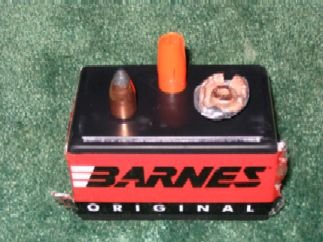
The following picture shows an unfired .458 Barnes Original, the proper MMP sabot along with one I recovered at about 130 yards out of the dirt, displayed here viewed from the bottom. Expansion exceeds 225%.
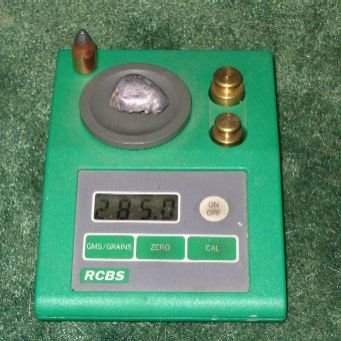
The weight retention of this recovered bullet is an amazing 95%, as you can see:
In no way can I represent that this is exactly what will result from firing on living tissue with circulation; I don't believe there really is any substitute for the genuine article from any source. Killing dirt, wet newspaper, or even ballistic gelatin only tells us how well a bullet kills these substrates, not what performance on game is. In the case of ballistic gelatin, the lack of bones makes it obvious that it is inherently flawed when used as a direct indicator of terminal performance on game.
Even though the more conventional design of this bullet does not allow for the 100% weight retention of a Barnes MZ-Expander, and core separation could be a possibility, the astounding accuracy of this bullet and its superb flight characteristics make it the bullet that is coming out of my muzzle on the next hunt. I'm not aware of any significant body of data concerning the muzzleloading use of this bullet, so it looks like I'll just have to find out for myself. That's just part of the hellishness that is my life.
Added to the uncertainty is the slight design change that Barnes has implemented to this bullet compared to its original form. Early Barnes bullets had jacket thicknesses exceeding .040 in. Currently, this pure copper and pure lead bullet has a .032 in. thick jacket-- still substantial, still tougher than most bullets, but the reduction in jacket thickness was made to allow for more expansion.
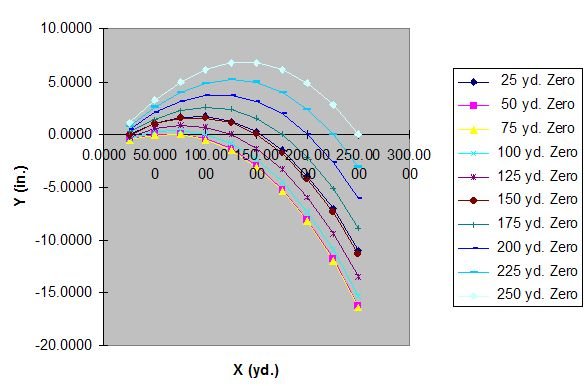
The nose of this bullet is pure lead, so you will want to use a ramrod tip that fits the ogive, being careful not to mash and smash the nose during seating with a blunt tip. Assuming a 2100 fps muzzle velocity, this bullet has a 6" kill MPBR of over 200 yards, retaining over 1600 fps velocity and 1700 fpe at 200 yards. Maybe now you can see why this, coupled with its great accuracy, has me excited about this bullet? Moving the Barnes .458 to 2272 fps with 60 grains of Vihtavouri N120, here are all the details:
Email: [email protected]
© 2005 by Randy Wakeman