


The Best Deer Hunting Muzzleloading Bullet
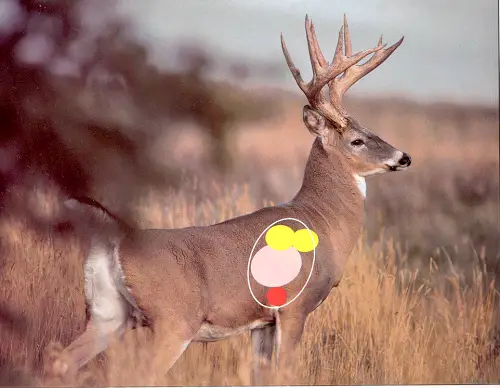
(Photo courtesy Ian McMurchy of Regina, Saskatchewan. The yellow designates the high shoulder / spine area, the pink the lungs, and the red the heart.)
The search for the "best" deer hunting muzzleloading bullet continues, and as evidenced by the many bullet debates that twaddle on with a cacophony of shrill discord-- consensus will likely never be reached. We all too often fall into the same trap; that of giving far too much credence to our own personal experiences. No single man's lifetime experiences are enough to bear close scrutiny, though the efforts should be applauded. Famous poacher John Taylor concocted his "Knock-Out" values based on his observations of non-expanding bullets on charging African game-with laughable results when applied to North American game. Feisty Elmer Keith ('Heck, Was He Really All There') has given great contributions to the art of pistol hunting, the significance of which is beyond dispute. However, Mr. Keith's personal disdain for Jack O'Connor clouded his judgment when evaluating the .270 Winchester and .30-30 cartridges-- finding them woefully inadequate to harvest deer with. By personally characterizing the .270 as a gopher gun, the other more significant contributions of Mr. Keith have become tainted. In the same way, the overzealous claims of bullet manufacturers and gun manufacturers have left the muzzleloading world with a peculiar mix of myth, misinformation, and hyperbole.While the North American deer populations dwindled to under 400,000 head in the early 1920's, today North America can brag as being the home of some 36,000,000 animals. Millions are harvested annually; the biology of deer family animals has not changed in the time anyone reading this has been alive. Few muzzleloaders have in-depth knowledge of anatomy as does Dr. Gary B. "Doc" White, or have the time or inclination to define terminal wounding from a scientific viewpoint as has Dr. Martin L. Fackler. However, there are some trends that can be easily spotted in game-getting, so obvious that I am compelled to comment on them myself.
There are three fundamental considerations in muzzleloading projectile bullet selection: accuracy, terminal performance, and trajectory. No one bullet stands alone in all categories, for if that was the case that is what we would all be shooting. In muzzleloading bullet and load development, while I'm not a believer in the "Beware the Man with One Gun," I do believe that "Beware the Man with One Bullet" is more germane to muzzleloading. One bullet is all we can use in most cases. One bullet is what most inline rifles show a preference for, and one load gives us a lot more time to become familiar with trajectory of that load. Most muzzleloaders today shoot only seven times a year-- that isn't range sessions; that is shots per year. Observations like that should surprise few, as muzzleloading is a deer hunting driven sport--and scant few deer hunters pound shotgun slugs into paper relentlessly, or undertake the same discipline with their 300 WinMags, for example. For those interested enough to read these introductory comments, I will attempt to at least touch on the three stated basic areas.
ACCURACYI define accuracy as the ability to accurately place a bullet in field conditions. This necessarily means that trajectory is included, as resistance to drop and windage are forms of accuracy. That co-mingles the "accuracy" criteria a bit. While it is true that deer don't care how fast you miss them, muzzle velocity and ballistic coefficient are the only primary values in trajectory. With deflagrating (fast-burning) propellants a huge velocity penalty is paid by using heavier bullets; this is partially compensated for by the better ballistic coefficients of longer, heavier bullet of the same configuration leading to a compromise situation from the start. This means saboted bullets are clearly the best trajectory choice; there can be no serious dispute about that. Saboted projectiles are smaller than bore-sized, and the resultant smaller caliber automatically gives those better ballistic coefficients and sectional density. I'm not suggesting that bore-sized projectiles are not effective game-getters when used within their limits-- but, they are severely ballistically challenged when compared to saboted projectiles of similar weights.
Accuracy is something that listening to your gun can tell you and you alone. Inline muzzleloaders are generally 1:24 to 1:28 rate of twist barrels. Forty-five caliber projectiles in .50 caliber projectiles have been the gold standard in inline muzzleloading projectiles for years, now. While .429 (.44 cal.) and smaller projectiles can be accurate, and I've found many of them to be accurate-- the higher performance powder charges limit them. The reason is fairly straightforward; the polyethylene sabot functions as a gasket, and as in most any gasketing application you can find-- the thinner gasket, the better. Del Ramsey's current blends of MMP sabots have improved to the point where now .40 caliber projectiles (and .429 caliber) can be used where just a few years ago they could not be; however the material limitation of being able to be loaded from the muzzle is a very real barrier to the very strong, stiff elastomeric compounds as used in "Accelerator" cartridge rounds, or saboted shotshell slugs. Moreover, the surface area of the base of the bullet subjects the sabot to less thrust per square inch. It is for this reason that rounded corner, flat base bullets can take hotter charges while maintaining accuracy. Concave or "dished" base bullets do not generally fare well-- and boat tail bullets also inflict more punishment on a smaller sabot thrust area.
The most accurate (by weight) projectiles are swaged lead, the Barnes Expander, then jacketed pistol bullets, in that order. Sorting pistol bullets by weight can close the gap to the point where group size variances by weight are not discernable out to 200 yards. Cannelures are a known ballistic crippler, so smooth projectiles are better assuming all else is equal. To add to the mess, all else is rarely equal.
There are always exceptions that prove the rule, but a recognizable trend of proven saboted bullets is actually rather small: the Barnes MZ-Expanders, the Hornady XTP series, and lead saboted bullets. Winchester Platinum Tips and Winchester Partition Gold bullets deserve special mention because they are so well designed and tested, the limitation at present being that only one grain weight (260 gr.) is available from Olin Corporation for today's muzzleloading enthusiast. They have not been the most accurate in any rifle I've ever tested though, but have qualified for all the field accuracy you can use in some of them. What is hyped and what sells is not always the best choice, and the overlooked Winchester Platinum Tip bullets display that quite clearly, as well as a bit sadly.
TERMINAL PERFORMANCE
This is an area that the vitriol can really start to flow. We ask a lot of our bullets, and we seem to want the same type of subjective terminal performance at all ranges regardless of whether we are breaking an animal down (smashing though shoulders) or going for the more generous "honey hole" area. For starters, it should be self evident that a relatively large hole in the vital organs of deer sized game does not allow it to live very long. With good shot placement, even hard cast or other non-expanding bullets get the job done as a .45 caliber hole through the vitals produces huge wounds. At the same time, while necessary to reach the goodies in well-armored African game, expanding bullets do produce more devastating permanent wound cavities in deer-family game with little question. This results in a universally accepted quicker, cleaner harvest, fewer steps taken by game, and easier recovery of that game. The laser beam effect remains, though a .45 caliber laser is admittedly a big one. As Dr. Fackler has proven, the yaw that always happens when a bullet enters the body cavity crushes and destroys a tremendous amount of tissue. The longer the bullet, the more crushing can be expected. 300 grain bullets provide that, and are superior to their 250 grain counterparts assuming they hold together.
Ian McMurchy's bullet collection, partially displayed in his beautifully produced, "Modern Muzzleloading for Today's Whitetails" [Krause Publications, ISBN: 0-87341-951-0, © 2000 by Ian McMurchy] gives beautiful examples of recovered bullets. As noted by Mr. McMurchy, the explosive effects and resultant hydrodynamic shock produced by high velocity center fire rounds that can instantly overwhelm the central nervous system of a deer are not as predominant in muzzleloading applications. Unfortunately, the ad-copy brags about muzzle velocity and energy are misguiding; that is of course, you seek to shoot your animal from the muzzle. Velocity and energy on target is what counts, muzzle ballistics are just a starting point, and a poor one at that. If you really care to know what you are popping a game animal with, you need to sail a bullet over a chronograph at that range. The rest is speculative, though certainly an accurate ballistic coefficient and accuracy muzzle velocity make it an educated guess.
The questions posed again and again are this: do "button head," or mushrooming bullets take deer more humanely, more quickly than limited (advertised as 'controlled') expansion bullets? Does a bullet that stays in an animal kill more quickly than one that exits? The answer based on ballistic laboratory data is, "NOT EXACTLY." The quick expanders expend energy before vital organs are contacted, that means very little. Necessarily, the more frontal area expansion is prevalent, the less penetration is possible. Also, the velocity retained when passing through the animal drops as well-resulting in less collateral damage. A necessarily vague answer is that some expansion is better than none, but inadequate penetration due to premature expansion can be problematic based on shot placement and banging big bones as well. Compromise is indicated, and we sure have a lot of room to move in that regard.
Based on the evidence seen first hand, the current literature, and continuing trends-- I believe that if a proven expanding bullet is employed (Hornady XTP) a 300 gr. arena bullet will clearly harvest where lighter bullets cannot due to the better sectional density. Indicated for large Russian boars and elk, it remains optional but recommended on lighter deer versus the 250 arena. With the Barnes Expander line, the 245 gr. Spitfire (if accurate in your gun) by virtue of fabulous weight retention and limited expansion is a preferred choice. With pure lead sabots, I bow to the wizardry of Doc White, and find the 285, 325, and 375 gr. offerings by Mark Lynch (Hunterman Boolets) and Ron Dahlitz (Buffalo Bullets) give both excellent expansion, and have enough sectional density to drive the bullet on though where the lightweights stop.
TRAJECTORY / BALLISTIC COEFFICIENT
Already touched upon, trajectory is a form of accuracy, though some have not viewed it in that way. BC is the last stop on the bullet trail in frontloader city, as no relatively heavy, large caliber projectile can fly that flat. As my friend Chuck Hill has noted in his rather extensive chronograph work, anything over a G1 value of .20 is a bonus.
Many ballistic coefficients are insidious, smarmy lies perpetrated only to sell bullets, just as the chronographs have clearly proven the Precision Rifle Dead Center bullets to be. A real pity, but so few muzzleloader check their own BC's., or use chronographs, it is easy to get away with false advertising. Sierra leads the way in accurate ballistic coefficients, one of the few companies that do not use static BC's. Olin-Winchester does their homework, using their own in-house Doppler radar range. Hornady get somewhere close, but their methodology remains unknown. Barnes BC's are as spot-on as 200 yard average BC's can be, and Buffalo Bullets has actually paid to have some of their BC's independently recorded. Belief in a bad BC can cause you to take a shot you otherwise would not, and would have you think that you are taking your animal with more energy on target than you really are. A conservative BC can cause no harm, by contrast.
Ballistic coefficient can give you a lot of things for free. Free trajectory, free retained energy on animal, free expansion or penetration, and by free- - I mean all with the same initial muzzle velocity, recoil, and powder charge.
ANCILARY CONSIDERATIONS
Lead bullets shorten and belly out upon firing (obturate). This gives a large, clear muzzle velocity loss vs. jacketed or Barnes copper bullets with the same propellant charge, same weight bullet. Thin jacketed bullets may do the same, but to a much lesser degree. Barnes bullets give the very best muzzle velocities, as they do not obturate measurably at all.
Pure lead bullets are relatively easy to load, and their easy obturation (while costing velocity) makes them forgiving to the variances found in today's muzzleloading rifle barrels. They are also fragile; and need extraordinary care in handling to remain looking like bullets. Finally, they have a finite velocity ceiling of 2100 fps or so. Beyond that, they distort in flight.
Jacketed pistol bullets are economical; the bulk purchase of loose Hornady XTPs (for example) allows you to obtain current formulation sabots direct from MMP. They remain looking like bullets with little care.
Barnes Bullets come with MMP sabots as a matter of course (so do Buffalo SSBs), so no sabot shopping is normally required. Sabot to barrel fit is critical with Barnes bullets, that slight interference fit is all the difference in the world between a 1" group and an 8" spray. The 245 Spitfires work well in most Thompson's, the 250 or 300 Expander MZ examples seem better fitting in most Knights, Savages, etc.
CONCLUSIONS
With relatively light charges and when the ranges are short, your options increase tremendously. For example, the vast number of .429 pistol bullets and lightweight bullets have been shown to effective inside 100 yards with moderate charges, the ranges where most deer are taken. Bore-sized conicals, despite their limitations, also have done well inside 100 yards. The 348 gr. swaged lead copper plated Powerbelt is one of the best of the conical breed by having no cannelures, lubrication issues, or velocity limitations like the 1300 - 1350 fps ceiling of lubed lead conicals. Despite ballistically very poor, heavy conicals also do well inside 100 yards. You don't need 460 grains to take a deer, but the sheer mass of the bullet covers its other defects (casting variations, hidden voids to name a couple) well. While workable, I believe we can do better, particularly when longer ranges are a possibility. Substantial documented data shows that we have. It should be apparent that the preferences expressed here are based on high-powered loads, suitable for long range, less than ideal shots, and are bullets equally at home on moose, elk, and boar as they are on deer only. Beware the Man with One Bullet. The better bullets tested are listed below.
For those who appreciate flat shooting, accurate bullets that can handle raking shots and really rough rides, the Barnes Spitfire 245 and the Barnes Spitfire 285 are preferred choices, if you gun "likes" them. Thompson rifles show that they do, it is a good possibility on current Knight Rifle production, but can be hit or miss on many other brands. They can well tolerate high velocities. For the Savage 10ML-II, the .45 / 50 300 gr. Barnes MZ Expander continues to impress.
The medium-weight saboted match-grade lead bullets as custom made by Mark Lynch of HunterMan Boolets in Michigan are beautifully handcrafted; Mark can be reached at [email protected]. Mark can make his saboted .451 pure lead and his specialty alloy 2S ogive spitzer boat tail projectiles resplendent with MMP sabots in any weight you designate, and I can personally attest to the quality of the product, and Mark's fine customer service. The .451 260 gr. and 280 gr. Hunterman Spire Specials are particularly forgiving in a wide variety of rifles. Mark's specialty alloy versions increase MV and remove the inherent velocity limitations of pure lead.
Buffalo Bullet's updated swaged lead 285, 325, and 375 SSBs .451 / 50 are popularly priced, and well worth a try. They automatically come with MMP sabots as well. An interview with Ron Dahlitz appears elsewhere on this site: Ron can be reached at 800-423-8069.
In the mass-produced pistol bullet line, the Hornady .452 250 gr. XTP is a proven winner, combined with the MMP short black sabots. The .452 300 gr. Hornady XTP exceeds the 250's terminal effectiveness in the majority of scenarios, and is a clear choice for those wanting pass-through performance or for tougher game in addition to deer only.
Personal preferences are just that. My personal "Numero Uno" at present is the Barnes .451 / 50 300 gr. MZ Expander, for cited reasons. Its G1 BC value of .207 is realistic, and as the most proven Barnes muzzleloading bullet, it opens up down to 1000 fps. In terms of overall performance, it has yet to be equaled in my view. The Barnes Original 300 grain .45-70 bullets, (.458 diameter) married to MMP orange sabots have given astonishing accuracy, and are the flattest shooters I've used to date. It is Barnes Originals that will go on future hunts when longer ranges are anticipated. Coverage of the Barnes muzzleloading bullets appears elsewhere on this site. All these bullets have the capabilities to comport to your personal paradigm of high performance in-line game-getting satisfaction. As always, let your gun tell you what it likes to be fed. It knows far better than anything else what combination suits it the very best.
Email: [email protected]
© 2004, 2005 by Randy Wakeman