


Sectional Density and Muzzleloading Projectiles
Sectional density is an important component of a bullet's ability to penetrate, and destroy the vital organs of a game animal requisite for a quick kill. Chuck Hawks clearly, concisely describes and compares sectional density here: http://www.chuckhawks.com/sd.htm so I'll not duplicate what Chuck has already set forth so extemely well.
Dr. Martin Fackler, the world's foremost expert on wounding ballistics has documented the better wounding of longer, heavier bullets. The FBI Quantico study has done the same, showing that longer bullets produce greater wounds and have greater lethality. The longer, heaver bullets naturally have greater sectional densities as well. Along with the better sectional density for a specific bullet design comes less velocity erosion with the automatically higher ballistic coefficient, and perhaps more important to the muzzleloading hunter: less wind drift.
It is not that the worst sectional density muzzleloading bullets have not harvested game; even the ballistically challenged round ball has taken its fair share. Under ideal circumstances, a broad side or honey hole shot, fragile, easily frangible bullets do work. When the angles are less than perfect, and raking shots or through the chest shots are needed-- poor sectional density muzzleloading bullets have failed. By fail, I mean fail to drop the animal quickly, resulting in either a long tracking attempt or lost game. I've witnessed too much of this, and a commonality has been bullets with poor sectional density. Sectional density is important in rifle bullets, handgun bullets, and muzzleloading rifles are in no way exempt from the fundamental results from good (or poor) sectional density projectiles documented over the decades. When the game gets larger and tougher, sectional density becomes even more vital.
A muzzleloading projectile with a section density below .200 is deficient for the more demanding shots on thin-skinned game (CXP2 class), and for even a greater variety of shots on heavier game animals(CXP3 class). I'll be specific as to what bullets look borderline; of course you are the final judge of how, where, and why you might take a specific shot at an individual game animal.
POOR
.40 caliber Hornady 200 grain SST: SD = .179
.452 caliber Hornady 250 grain SST: SD = .175
.490 caliber (".50 cal. Roundball") 177 grain SD = .105
.50 caliber (.499) Powerbelt 245 grain: SD = .141
.50 caliber (.499) Powerbelt 295 grain: SD = .169
.50 caliber (.499) Powerbelt 348 grain: SD = .181
.535 caliber (.54 cal. Roundball) 230 grain: SD = .115This is a 250 grain Hornady SST was recovered from a 75 yard broadside shot placed behind the shoulder into a Michigan 4-point at 70 yards, pushed by 90 grains of Pyrodex. Despite the excellent shot placement, the 135 lb. field dressed weight buck still traveled over 75 yards before finally piling up.
In areas requiring instant anchor for confident quick game recovery, this bullet is a very poor choice. In fact, more deer were lost in a specific coastal carolina hunting camp with SST's in ONE year than in in the prior ten years with 300 grain XTP's. Failure to kill quickly, failure to recover animals, and poor sectional density go hand in hand way, way too often.
GOOD
.458 Barnes Original 300 grain: SD = .204
.451 Barnes Spitfire 285 grain: SD = .200
.451 Barnes MZ-Expander 300 grain: SD = .211
.451 Buffalo SSB 375 grain: SD = .263
.452 Hornady XTP 300 grain: SD = .210
.458 Hornady HP #4500 300 grain: SD = .204
.50 caliber (.499) Powerbelt 405 grain: SD = .232There are other considerations beyond sectional density you might wish to evaluate. Pure lead pancakes at low velocities, inhibiting penetration. This makes the lighter Powerbelts which are nothing but soft lead, and lead roundballs penetrate even less than their dismal sectional densities might indicate. The lead 375 grain Buffalo SSB is far more likely to get you where you need to be in less than ideal hunting circumstances.
Flipside, Barnes all-copper bullets by virtue of their 100% weight retention potential, have been proven to out-penetrate thin-jacket bullets by a large margin. So, though a 245 grain .451 Barnes Spitfire has a sectional density of .172, it penetrates like a substantially heavier bullet. The same is true for the new .193 SD Barnes .451 275 grain XPB, which has already proven itself by out-penetrating its 300 grain jacketed competition.
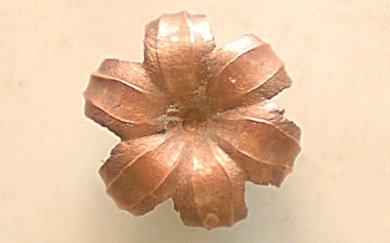
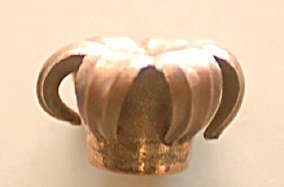
This 245 grain Barnes Spitfire was placed into the chest, a head on shot by Bill Konway of Indiana using 150 gr. of Triple 7. The bullet traveled the entire length of the animal, exited near the groin, re-entered the inside of the hind leg, and finally came to rest at the back of the hind leg. The deer traveled zero yards; you can see both the excellent expansion and 100% weight retention. This was an instant kill with the all-copper Barnes Spitfire, but a very risky shot with a low sectional density conventional bullet on deer-- even more ill-advised on larger game.
Use of bullets with sufficient section density enable you to quickly kill and retrieve big game that otherwise would be lost in dense cover or with raking shots. It is something that Elmer Keith, Jack O'Connor, Charles Askins, the FBI-Quantico, Dr. Martin Fackler, Ballistics Engineer Paul Von Rosenburg, Dr. Gary "Doc" White, and Duncan MacPherson have all universally embraced in various ways.
A few personal examples:
Manitoba caribou, .451 340 gr. lead bullet @ 157 yards SD= .239: Zero Steps.
Kuujjuaq, Northern Quebec caribou, .277 150 gr. PG @ 220 yards SD= .279: Zero Steps.
Newfoundland Bull Moose, .277 150 gr. PG @ 327 yards SD= .279: Zero Steps.
Russian Boar, Tenn., 300 gr. Barnes MZ-Expander @ 30 yards SD = .211: Two Steps (running).
Corsican Ram, 300 gr. Barnes MZ-Expander @ 165 yards SD = .211: Zero Steps.
Feral Hog, deep south Texas, 300 gr. Barnes MZ-Expander @ 171 yards SD = .211: five yards.
Pronghorn, .277 130 gr. Nosler @ 227 yards, SD = .242: Zero Steps.
All one-shot kills, all instant anchor, all with bullets with a sectional density exceeding .21.
© December, 2005 by Randy Wakeman
Email: [email protected]