


On Accurizing the Savage 10ML-II Muzzleloader
There has been a flood
of questions about what "needs" to be done to the Savage
10ML-II, or what "should" be done to the Savage 10ML-II for
the sake of accuracy worship. I'll try to touch on a few points that,
hopefully, will offer perspective and a bit of food for thought. There
are no cozy, quick, cute, all-encompassing answers.
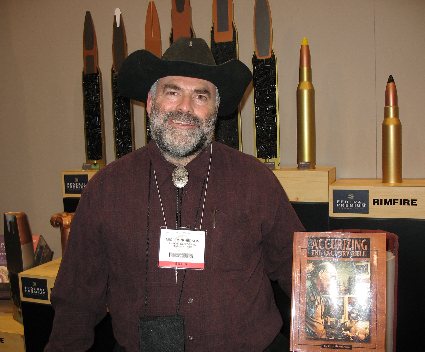
Mic McPherson shows me a copy of the best book ever written on rifle accurizing, as far as I'm concerned. I don't think Mic strongly disagrees.
Like anything else, it is hard to "unmodify" a modified rifle; metal is not easily sanded back on. Anyone that is truly serious about accurizing the Savage 10ML-II (or any rifle, for that matter) would be doing themselves a great favor by getting a copy of Accurizing The Factory Rifle by M. L. McPherson. Mic McPherson's outstandingly good work is required reading for aspiring gunsmiths; it likely should be required reading for anyone who seeks to get the most out of a rifle. Some of us have far more dollars than sense, and there are always a few that are most happy to help those in that situation. Accurizing The Factory Rifle breaks down what makes sense, what does not, and will likely save you dozens of times its modest price in a short period of time. It is the single best investment anyone can make. After digesting Mic's book any future decisions you make will be from a position of being far better informed rather than just trying to fix what isn't broken. You can get it direct from Mic right here: http://www.levergun.com/order_forms/order_books.htm .
A little background is in order. As far as commonly available muzzleloaders today, few are offered with any accuracy standard at all. I have no hesitation in saying that Thompson is a good company; they really are. However, they offer no accuracy guarantee at all with their rifles. Knight Rifles does: 2-1/2 inch three shot groups at 100 yards. Savage Arms promises you a muzzleloader capable of 1-1/2 in. 100 yard accuracy out of the box. That has been the case for nearly seven years now-- no other mass-produced muzzleloader made promises you this.
I've monitored Savage Arms 10ML-II factory 3-shot test targets as best I can for a few years. Most often, these groups are fired with 42 grains of N110, a "MMP" sabot, and a 250 grain .452 diameter Hornady XTP-- hardly a "match grade" bullet. More recently, 42 grains of SR4759 has been used as well with the same bullet and sabot. This is just a generic Savage Arms targeting load; no effort is made to work up a load for an individual rifle. The 3-shot, 100 yard test targets I have seen run from .56 inch to about 1.3 inches. Considering the 10ML-II is a big game hunting rifle, it is far more accuracy than can possibly be used in the field. Nevertheless, I'm both happy and a bit amazed that they do so well. Still, we want more-- or, at least we think we want more. It is the "American Way," I suppose.
To continue the accuracy quest, a few things are presumed. It is presumed that you have quality steel bases and rings, a quality scope, current formulation MMP sabots of the same lot number from MMP, you are using powder with the same lot number, and you are sorting your bullets by weight. There are no 'bench rest' 209 shotshell primers, but it is presumed you are using the same brand and the same lot number of 209 primers as well. Many purported 'accuracy issues' have been traced to loose scope bases, or reticle float inside a scope tube. If the reticle in your scope does not return to the exact same spot after recoil, there is very little hope of accurately gauging your progress. A solid rest is also assumed, as well as good range conditions. Gusty winds and large caliber bullets do not mix particularly well.
Consistent loading
of your sabots is also presumed. Seating pressure affects the burn profile
of most any small arms propellant. Using 10 pounds of ramrod pressure
then 50 pounds of ramrod pressure for the next shot cannot help promote
accuracy. Canting or cocking of a bullet also cannot help accuracy. The
"SpinJag Loader" is the most precise loading jag available today. 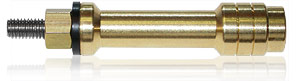 It has a built-in
bore guide, and is not a cleaning jag-- only a loading jag. The
SpinJag Loader mates closely to your bore; there is little room for canting
or cocking a saboted projectile upon loading. See http://www.spinjag.com. There is also no room for a cotton patch,
which is not needed between shots in the 10ML-II when shooting smokeless.
Smokeless residue is primarily light ash. I've found Vihtavuori single
based powders (N110 and N120) to be particularly clean. A quality
through-hardened machined ventliner is also presumed-- that's why I make
them available.
It has a built-in
bore guide, and is not a cleaning jag-- only a loading jag. The
SpinJag Loader mates closely to your bore; there is little room for canting
or cocking a saboted projectile upon loading. See http://www.spinjag.com. There is also no room for a cotton patch,
which is not needed between shots in the 10ML-II when shooting smokeless.
Smokeless residue is primarily light ash. I've found Vihtavuori single
based powders (N110 and N120) to be particularly clean. A quality
through-hardened machined ventliner is also presumed-- that's why I make
them available.
Many, many things affect point of impact. Breathing, triggering, shot call, forearm pressure, and the clothes we wear are all factors controlled by the nut behind the butt. The Rifle Shooter, by David Tubb, is requisite reading and worthy of anyone's study on and off the field. Many claim to somehow be "benchrest shooters," but have won nothing in their lives. David Tubb not just competes; David Tubb wins. If we want to improve, we might as well learn what we can from the best-- and David Tubb qualifies. See http://www.zediker.com/books/rifleshooter/rifleshootermain.html .

When it comes to marksmanship, David Tubb (right) is one person really worth listening to. I certainly have.
All this, and we haven't turn a single screw or made a single modification to our rifle yet? You bet-- our own shooting skill is a factor in everything. It may be more convenient to seek a mechanical solution to an organic problem; perhaps that is why we do it?
You've likely heard a bit about crowning or recrowning barrels. Certainly the barrel crown is an important part of the barrel-- but far less meaningful in sabot shooting muzzleloaders for the simple reason that a sabot is between expanding gas ('jet effect') and the bullet. Crowning work, barrel porting, and muzzle-breaks have largely proved to be a waste of time with sabot-shooting muzzleloaders-- so says master riflesmith and inventor of the Savage 10ML system, Henry Ball, Tony Knight, Dr. Gary 'Doc' White, and many others.
Combination muzzleloader big game hunters and accuracy buffs are commonly a frustrated lot. We like to have it both ways-- extremely high velocity coupled with the 'best' accuracy. The problem is that the all-out fastest load is unlikely to be an 'accuracy load.' The fastest thing out of the muzzle is rarely the most accurate centerfire load, the most accurate rimfire load, the best patterning shotshell load, and certainly is not normally the most accurate muzzleloading load. Speed, heat, and pressure stresses sabots. Recoil stresses scope and shoulder alike. No one I know, or have ever heard of has claimed that their personal accuracy improves in concert with recoil: quite the opposite. That is a compromise that is ours alone to make. Sixty grains of blackpowder has won paper muzzleloading matches for years, but not 100 or 120 grains. This is not entirely a complete coincidence.
Yes, and we still have made no gun modifications or wasted any money on modifications. Sorry about that. Let's move on to barrel floating. The idea of barrel floating is to allow the barrel harmonics (that are unique to every single rifle and load) to occur naturally, without stock interference impeding the tuning fork effect. The Savage 10ML-II is normally supplied with a fully floated barrel. However, occasionally they may ride one land of the stock. A few moments with #0000 steel wool or ultra fine sandpaper and a dowel rod, and your barrel is properly floated. We want our barrels floated, we seek natural barrel harmonics, yet we hang a weight right from the end of our barrel. A thimble and a removable ramrod cannot possibly improve accuracy. We are better off shooting sans ramrod.
Some folks apparently are wasting their money by having their rear action screws drilled and steel pins inserted. This makes no sense. As is, the screw is hard enough to raise a burr on the bolt if you yank your bolt open like a jack-hammer repeatedly. This something that Henry Ball has scolded his troops for, for many years. The bolt on a Savage 10ML-II does not need to be yanked back like you are ejecting a huge hunk of brass from a Mauser 98-- as you are ejecting nothing. No fast bolt speed is required.
There is some talk of "head-spacing" a breechplug. This naturally is rubbish. The Savage barrel nut has a 1:16 thread. To maintain action-barrel integrity, it must be rotated 360 degrees. That, of course, is 1/16th of an inch, or .0625 in. Optimum firing pin protrusion is about .045 to .050 in. This should make it clear how senseless headspacing of an individual breechplug really is. Even if it was done for an individual breechplug, you run the risk of creating a real dog. Will it be 'headspaced' to any other breechplug? 209 shotshell primers vary from brand to brand, are mass-produced, and cheap. If, in the unlikely event your bolt is hard to close with Winchester 209 primers, a very light polish of the primer pocket addresses this in a hurry. Or, just swap breechplugs. Cracking a barrel nut for this is a long way to go for nothing.
Naturally, crowning a barrel or having an unauthorized source machine the action voids your Savage warranty. Savage Arms cannot be responsible, and is not responsible for unauthorized modifications to your rifle. That may be confusing the issue with common sense, but that is the case nevertheless. Henry Ball's method of removing all the Savage factory pillars, and using three pillars of his own design along with a nested escutcheon is a far cry from "just adding a third pillar." Adding a third pillar cannot improve accuracy; that was never its purpose. It can destroy it, however, and renders the rear action screw inert. Save your money and your warranty.
What about bedding? Bedding is extremely well-covered in Mic McPherson's Accurizing The Factory Rifle cited above. Properly executed bedding can never hurt 10ML-II accuracy. The mount of accuracy improvement is an individual event contingent on the stock inletting fit of your individual rifle. Legendary hunter and gun-writer Jack O'Connor noted that, in his entire collection, only one of his rifles hand been hand-bedded. Guns & Shooting Online staff conducted a series of incremental accurizing steps on centerfires. On one rifle, proper bedding cut group size by 50%. On the second rifle, group size was reduced by ZERO percent. There can be no exact prediction as to what bedding will do for an individual barreled action in an individual rifle. An expert bedding job is one of the few common-sense approaches to accurizing. If your gun is already shooting MOA, it is not realistic to expect a touch of bedding alone to give you a ¼ MOA gun. The best I can say is that proper bedding can help and cannot hurt. You can have it done or you can do it yourself, the way you want. Brownells has all the Acra-Glas you would ever need. The same generalizations made for Savage short action centerfires apply. Typically they are supremely competent shooters right out of the box, a touch of bedding (either skim bedding or full-length bedding) may help tighten things up a bit. A custom match grade barrel, short and extremely fat, starting with Dan Lilja or John Krieger is a way to explore accuracy as well-- one that will likely run far more than the cost of a new 10ML-II and may require stock work as well, but-- it is a path that can be taken albeit an expensive one and one that is not particularly compatible with big game hunting.
I happen to be an Accu-Trigger fan. It makes the triggers supplied on most muzzleloaders look particularly sad. However, some seek a 10 oz. competition trigger for paper work-- though not suitable for most big game hunting. The Sharp Shooter Supply Competition trigger is a drop-in replacement that adjusts from 10 oz. to approximately 2 pounds, and it may provide you with as much effective bench accuracy as any other modification. See http://www.savageshooters.net/sharpshooters/Triggers.html . An aftermarket trigger does not change a rifle's accuracy, but it may help an individual's. Like many things, accuracy is anywhere you can find it.
Bedding and perhaps a bench-rest trigger are two of the very few modifications that make sense. A third modification that Henry Ball believes in is cryogenic accurizing. A reputable source is 300 Below found at http://www.300below.com.
A reasonable approach is to confirm scope, bases, rings, and try a variety of load combinations letting your individual rifle tell you what it likes. With all the fundamentals out of the way, bedding, maybe a trigger, and maybe cryo work are sensible options to ponder. Muzzleloading big game hunters need do nothing to a stock 10ML-II at all. It is always better to drive a car first before you decide that it might actually need a tune-up.
Copyright 2006 by Randy Wakeman. All Rights Reserved.
Copyright 2011 by Randy Wakeman. All Rights Reserved.