


Why Riflescope Light Transmission Percentages Mislead
To
begin to understand why field performance of riflescopes, binoculars,
and other hunting optics seldom are universally agreed upon, a little
background of how human eyes respond to what we call light is in order.
This comes courtesy of Kenneth R. Koehler:
We call the 400 to 700 nm range of wavelengths "visible" because those are the wavelengths to which our eyes are sensitive. That range reflects the wavelengths of sunlight which reach the Earth's surface with sufficient intensity to excite the cells on our retinae. Minus absorption by O 2, H 2 O, etc., the "spectral distribution" (relative intensity as a function of wavelength) is a smooth curve with a peak at about 600 nm:
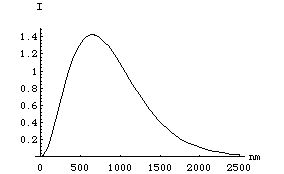
which is of course in the middle of the visible region. This spectrum
is called a "black body" spectrum, and represents the spectrum
of radiation of a "perfect" radiator (ie., the sun).
The physical process of seeing begins with the absorption of a photon
by a pigment called "retinal". We can define a pigment as a
substance which is "photoreactive", that is, which absorbs (and
possibly re-emits) wavelengths in the visible range. The absorption causes
a change in the geometry of the retinal (in the terms of organic chemistry,
it changes from a "cis" to an "all-trans" configuration):
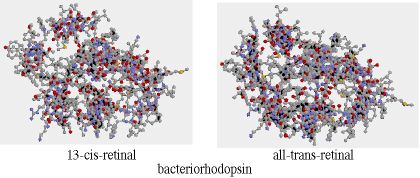
This change in geometry takes place in about 6 ps. It has the effect of
activating an enzyme (phosphodiesterase) which in turn hydrolyzes hundreds
of "cylic-GMP" molecules (guanosine 3' - 5' phosphate) which
in turn effects the sodium channels in optic nerves, initiating a nerve
impulse. (Note that at the level of proteins, geometry defines function;
this business of shape-changing, as well as "key and lock" shape
fitting, is a ubiquitous signaling mechanism in the world of molecular
biology.) The specific protein to which the retinal is linked determines
the range of wavelengths to which it is sensitive. Retinal linked to rhodopsin
has a peak sensitivity of about 496 nm. Rhodopsin is the protein in human
rod cells as well as in many photoactive organisms.
The cone cells of the human eye are sensitive to 3 wavelength ranges which
the eye interprets as blue (narrow, with a peak near 419 nm), green (broader,
with a peak near 531 nm) and red (also broad, with a peak near 558 nm,
which is actually more like yellow!):
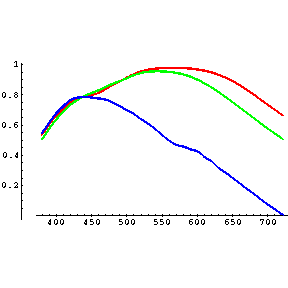
(from Vos, J. J. & Walraven, P. L.). All of the colors which your
mind perceives are constructed from combinations of relative intensities
of these three "wavelengths": red, green and blue are the only
"signals" your brain receives from your eyes. Recall that the
"intensity" of a sensation is proportional to the frequency
of nerve impulses. If 650 nm photons hit your retinae, your brain will
receive a mixture of green and red signals, with more red than green but
not too many of either. This will be interpreted as red. Similarly, 475
nm photons will cause about equal numbers of blue and green signals, with
only a few red; this will be interpreted as a sort of bluish-green. The
number of signals for any one of these ranges depends on both the intensity
of the light and the sensitivity at that wavelength. This leads to a vaguely
disturbing contrast between sensation and perception: your eye sends only
three kinds of signals to your brain, yet your brain "constructs"
the full color spectrum of "reality" from them. Now you can
understand why people can have violent disagreements over what color something
is: no two people see exactly the same thing, yet we assume that color
is something objective. Since most of us have similar sensitivities we
can agree on primary colors, so the garment industry has nothing to fear.
"Scotopic" (dark-adapted) and "photopic" (light-adapted)
sensitivities differ; scotopic peak sensitivity (of the rod cells) is
at about 500 nm, while photopic sensitivity (of the cone cells) peaks
at around 550 nm. Wavelengths shorter than 315 nm are absorbed by the
cornea (causing injury) and do not reach the retina. Retinal sensitivity
sometimes extends (with very low sensitivity) to 1000 to 1050 nm. Note
that if your eyes were sensitive to much longer wavelengths you would
look through a sort of "infrared fog", since you would see heat
energy everywhere.
The above is ©1996, Kenneth R. Koehler. All Rights Reserved.
It doesn't take a great deal of reason to discern that any "light transmission number" assigned to a scope is necessarily flawed. It is a far more complex dynamic than we perhaps would like to believe. When light levels are very low the viewing conditions are referred to as "scotopic." Under these conditions, the eye’s visual response changes dramatically. Sensitivity to yellow and red light is greatly reduced, while response to blue light is vastly increased. Our eye response does not shift suddenly from high light levels to low light levels. A gradual change occurs as light levels are reduced in twilight conditions. This is defined as the "mesopic" condition-- with eye response somewhere between "photopic" and "scotopic." Likely, this is more information than you'd like to digest.
Back to a comparison from the patent office:
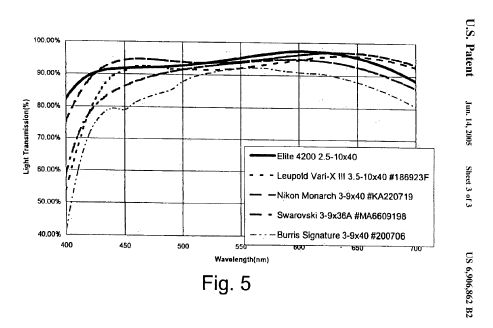
What our eyes interpret as "BLUE" (the narrow range peaking near 419 nm) is not addressed by light transmission calculations. Different coatings address different parts of the visible spectrum differently. As shown by the graph above, this 419 nm peak area has some supposedly good quality scopes transmitting well under 70% of the visible light in this area. If these words appear "BLUE" to your eyes, it is likely your personal eyes do indeed respond well to visible light in this area.
Perhaps now we can begin to agreeably disagree that no single scope will give the optimum image to all sets of human eyes under all conditions. All these scopes have been touted as "95% light transmission." It is not possible that they are, within the visible light arena of 400 - 700 nm many scopes transmit only 40% of the visible light at one wavelength or another.
No one I know would want a "40% light transmission" set of binoculars, riflescope, or spotting scope-- yet, often that is exactly what we are using in certain parts the light spectrum visible to the human eye. The fundamental benefits of fully multi-coated lenses, quality lense lapping, quality machining, and overall build quality still apply.
Yet, the final judge of field performance of any optical device necessarily rests with the eyes of the beholder. Technical details and machine testing can only go so far-- they are necessarily both flawed and a compromise. Not that this is a bad thing at all ... the best we can do in applying inorganic data to organic mechanisms is the best we can do.
A lifeless number just cannot tell the complete story of how any individual perceives any specific image, and is best used as a guide rather than something to become enslaved to.
For reference:
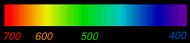
Visible light: 380-780 nanometers. The colors we see exist within a very narrow band called the visible light spectrum. Located between 380 and 780 nanometers (1-billionth/meter) this spectrum runs from violet/blue at 380nm to red at 780 nm. All the colors you see in nature are combinations of blue, yellow or red.
Ultraviolet rays: 100-380 nm. Photochemical in nature. When your skin turns red you are seeing the effects of UV radiation. UV consists of UV A, B, and C. UVC is absorbed in the atmosphere and is of little consequence to humans here on Earth. UVB is absorbed in the cornea and is a major cause of snow blindness or photokerititis caused by long-term exposure to UVB rays. UVA is absorbed in the lens of the eye and is the major cause of cataract formation. Cataracts can be found in elderly migrant workers, lifeguards, surfers and others who spend a great amount of time outside without proper eye protection. Almost all sunglasses today provide protection from all UV A&B rays.
Infrared rays: 780-1400 nm. Thermal in nature. When you feel heat on your skin, you are feeling the effects of thermal radiation. While exposure to infrared may lead to dry, tired eyes, its long term effects on overall eye health is still being debated. Sunglass lens colors and their variations will have differing effects on the attenuation of IR radiation.
Blue light: 380-400nm A short wave length ray on the edge of UV and Visible light, blue has a couple of major drawbacks; one, because of its short wavelength, the lens of the eye is forced to constrict to focus the light on the retina. This in effect causes a distortion in the other colors in a way that is referred to in the optical community as “chromatic aberration”. Some in the medical community feel that long-term absorption of blue light may be linked to eye afflictions such as macular degeneration. 100% blue light attenuation will increase acuity but a world with out blue is a strange world indeed. Most sunglasses allow for manageable amounts of blue light to transmit allowing proper color recognition while minimizing chromatic aberration.
Contact: Randy Wakeman, 12362 S. Oxford Lane, Plainfield, IL 60585
By phone: (815) 254-2135
Email: [email protected]
Copyright 2006 by Randy Wakeman. All Rights Reserved.