



The Magnificent Savage Breechplug
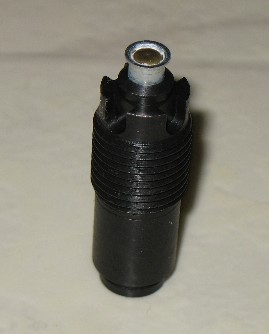
The breechplug of the Savage 10ML-II is remarkably different from generic breechplugs commonly seen in inline muzzleloaders. Just being different in and of itself means that the reasons for it are normally not appreciated. More than a few times, I've been asked why "other" manufacturers don't take the same approach: the short answer is that they can't, as it is patented. Old habits die hard, it seems.
At this stage of the game with seven years of continuous production of the Savage 10ML, it is hardly radical (or perhaps newsworthy) to consider smokeless powder muzzleloading. We can all consider how common shotguns have functioned for the last century: 209 primer, smokeless powder that is not corrosive, wad or sabot, and projectile or projectiles. Whether we push a saboted bullet out of a shotgun with a rifled barrel or shoot a Savage 10ML-II, the mechanics are the same-- no news there. What is newsworthy is that the Savage 10ML-II was designed, tested, and manufactured from the very beginning to use moderate to slow burning non-corrosive smokeless powders. The Savage was expressly designed and engineered for this, and the Savage breechplug is a fundamental reason behind its superior function.
Breechplug holes ("flash holes") erode and enlarge in any inline. Henry Ball took note of this some sixteen years ago, Doc White was aware of it long ago as well. Even recently, Hodgdon Powder noted that within one hundred shots or so, Triple Se7en eroded T/C Omega breechplugs. Hodgdon's testing was directed at trying to kill the Triple Se7en hard "crud ring" fouling. What Hodgdon took note of was already common knowledge to Henry Ball and Doc White. Breechplug flash hole wear is a normal occurrence; I've personally shot out both Thompson and Knight breechplugs to the point where accuracy was gone. The 'fix' is to screw in a new breechplug.
As normal erosion is related to pressure and heat, the hotter charges of the newer subs amplify what was already an established occurrence. Henry Ball wanted to resolve this issue before it affected accuracy, so that was why the Savage breechplug has a "ventliner" on the powder side. Without resorting to rare, brittle, or hard to machine metals, a 10ML-II shooter need only replace the ventliner, a screw with a hole in it that is a "replaceable flash hole," every box of primers or 100 shots to enjoy brand new gun ignition, performance, and accuracy. The ventliner is simply a replaceable flash hole, and as mentioned you won't see it on other muzzleloaders as it is protected intellectual property.
"BLOW-BACK" is talked about relentlessly. There are two different types of problematic blowback in a 209 ignition muzzleloader: internal and external. The external type is the easiest to observe as that is the type that burns scopes and in the case of a few muzzleloaders I've tested, your face as well. The Savage has none. The same can be said for a few other muzzleloaders, more or less.
Internal blowback is what you don't see from shot to shot. Internal blowback coats your bolt or break action with rock-hard primer and powder residue that must be cleaned out to prevent misfires, blocking of the firing pin, and operation of the action. It is the internal blowback that means the bolt of a Knight, Austin & Halleck, or what have you must be continually disassembled and cleaned. It is internal blow back that may gum-up the action of most every inline muzzleloader made today, except for the Savage 10ML-II. The bolt of a Savage 10ML is never disassembled for cleaning; in fact-- Savage gives no instructions for doing so, as it is not necessary. Let me mention why that is.
When a 209 primer is ignited the significant mass of primer compound has to go somewhere, and it does just that. In conventional inline muzzleloaders, the primer is pointed in the general direction of a nipple or center of a breechplug by a plastic fixture, held in place by a spring, or allowed to flop around a bit in an oversized primer pocket. There is no seal, so whatever makes it through the flash hole does just that, the balance blowing back into the action or perhaps leaking through it, toasting scopes and the like.
No such issue exists with the Savage 10ML-II. The primer is attached to the bolt by the horseshoe metal fixture, and positively located not just next to-- but actually inside the primer pocket as shown in the illustration. When the primer ignites, it instantly puffs out to seal. No significant primer mixture goes anywhere but through the breechplug. The primer attaching to the bolt is such a great idea, I'm often asked why the "other companies" don't take this obviously superior approach. Well, again, they can't-- as this innovation is protected by patent.
With the primer sealing in the primer pocket, the residue in a Savage 10ML-II does not migrate to scope or bolt, so cannot affect the operation of the rifle. No scopes get crispy, and the bolt never needs disassembly for cleaning as it doesn't get dirty to start with.
The primer crud stays in one place, that being the breechplug. So, after every 100 shots the ventliner is removed and a 5/32 in. drill bit is used to drill out the hard primer matter, going all the way through the breechplug starting at the primer pocket. The drill bit is self-centering, so you just hold the breechplug by the unthreaded portion with a set of pliers and drill all the way through with an electric drill. This is the only maintenance unique to the Savage, and your reward for this couple of minute operation is no external or internal fouling, and new gun performance. Most hunters drill out their breechplugs and replace the ventliner once a year whether it needs it or not. Though the ventliner should be coated with Mil-Spec 907E Anti-Seize compound, including the base of the flat-head screw, it does not need to be torqued down as it supports nothing but itself. Just screwing it down until it makes contact with the breechplug is all that is required.
This breechplug service is best performed before you ever shoot your new 10ML-II for the first time. When you get a new rifle, it is only natural to want to shoot it right away-- of course that is understandable. If you take care of your breech plug first, it will most likely take good care of you, and need very little care from you.
I've always had more motivation for doing things when I understand why they should be done; that's why I've sat on that cold rock and learned from Henry Ball and Doc White. I hope this article removes whatever mystery there might be about the Savage system-- it is a simple but superb premise, and is why the Savage 10ML-II has remained the only truly internally and externally sealed action production muzzleloader available today.
Contact: Randy Wakeman, 12362 S. Oxford Lane, Plainfield, IL 60585
By phone: (815) 254-2135 Email: [email protected]