

Browning Double Auto: Val Browning's Finest
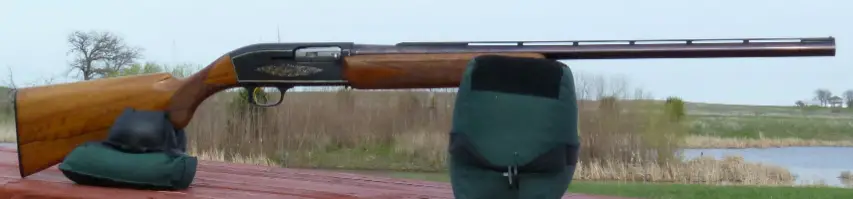
Above, my "Twentyweight" Double Auto, made in 1966. With its 26-1/2 inch ventilated rib barrel, it weighs just six pounds, three ounces.
Though not a great commercial success, the Browning Double Auto is a remarkable shotgun. The numbers of a firearm produced has never been a good barometer of quality, innovation, or desirability. Just because there are lots of MacDonald's cheeseburgers, Bic lighters, and cans of Budweiser sold every year doesn't make these products particularly good or satisfying. There are lots of marketing studies out there and those that sell this information. Some of it requires no great study at all. If it is on the shelf at anti-2nd Amendment Wal-Mart, it is doing some significant numbers.
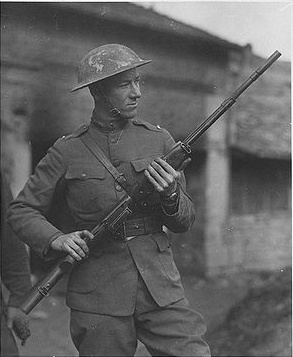
Val Allen Browning, son of “John Mose,” held some forty-eight firearms patents himself. It was Val Browning who completed the Superposed and the Hi-Power: John Browning himself never lived to see a production copy of either. The “speed loading” associated with A-5 and other Browning shotguns is a Val Browning idea, patent applied for in 1950, awarded in 1952.
Val Browning's Double Auto is one of the most innovative shotguns ever devised. The idea behind the Double Auto was to eliminate the unsightly forearm nut and offer quick barrel removal without detaching the forearm itself. It further was devised to save weight, bulk, and to soften shock both upon firing and when the barrel returns forward to battery. The first firearm and only firearm sold by the Browning Arms Company, founded after the passing of J.M.B., was the A-5, later joined by the Superposed. The third shotgun offering was the Double Automatic, added in 1954-1955 in the United States, after the original 1952 flop in Europe.
The Double Auto was devised to equal the handling, trigger quality, and responsiveness of the best double guns, with less cost and less recoil than possible with fixed breech guns. The superb balance of the Double Auto was achieved by complete elimination of the magazine tube. It is hard to find a center mass weighted gun with a tubular magazine with stuff hanging off of it; the Double Auto did away with it. The Double Auto features speed loading and speed unloading as well. The safety was made to be ambidextrous, so it was attached to the back of the trigger guard.
Despite its ostensibly simple design, it required a great amount of handwork to make. The Double Auto stocks were all checkered by hand, the receivers were all engraved by hand. The actions were all fitted with more handwork than you'll find today. As a result, the Double Auto was a costly shotgun to produce, selling for more than the already legendary A-5. It was billed as "Tomorrow's Gun Today."
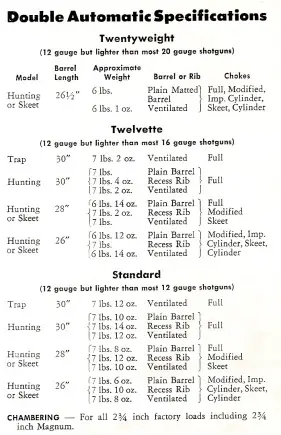
The exact production numbers aren't readily available, but they were low. From 1954 - 1972, the total number of Twelvette models produced were around 65,000 units, according to Ned Schwing. Yet, the demand for Double Autos was such that although catalogued for about eighteen years, in some years there was no manufacture of certain models at all according to Browning expert Jeff Tyler. Exact data remains murky, even according to the very knowledgeable staff at Art's Gun Shop.
For those that like the idea of a low maintenance shotgun, not only did the Double Auto need essentially no maintenance, the owner's manual actually cautioned against it. It reads, "It is unnecessary, and may likely be damaging, to have a gun taken apart annually for routine cleaning and oiling of the of inner mechanism." Aside from standard barrel cleaning and a light film of oil on exposed metal, you were allowed one small drop of oil on the breechblock and barrel extension guides.
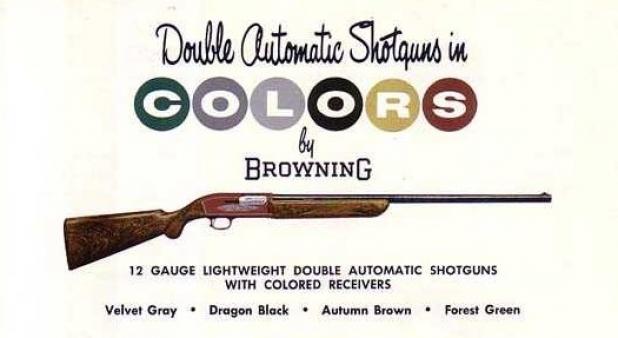
As far as "tomorrow's gun today," that wasn't all that far off the mark. As you can tell from the Browning catalog specs above, great attention was paid to the weights of the various models, none of which require adjustment to change from light target to heavier field loads. The "Twentyweight" was intended to replace 20 gauges, offering lighter weight and less recoil than most 20s, while the Twelvette was intended to offer 12 gauge performance with the carry weight and responsiveness of 16 gauges.
The amazing thing, to me, is that this was all done fifty-seven years ago. Alloy receivers in shotguns didn't get universal respect until the early 1980s, colored receivers are reappearing just now, the idea of "Superlight" is presented as a somewhat new idea, yet the Twentyweight is a bit lighter than the "world's lightest" 12 gauge autoloader, the Benelli Ultra-Light. The fast locktime of the Double Auto and the elimination of the fore end screw cap was only just recently touted in the form of the Browning Maxus.
The Double Auto steel version gained favor on the skeet field but then again the A-5 and other FN licensed Automatic-Five variations had long held that distinction as well. The Double Auto had and has what many shooters claim to want: low maintenance, effortless cleaning, light weight, all load capability with no adjustments, center mass balance, and is one of the few shotguns ever made that truly "hits like a 12, but carries like a 20." All this, with a slim forearm, extremely fast cycling, and the shortest receiver ever put on an autoloader. The Double Auto is also faster to reload than any break-action and faster than most autoloaders as well.
Despite all this, it wasn't profitable enough to remain viable as a production item. In 1963, the cheaper Remington 1100 was introduced with a quick and high level of acceptance. Handwork was becoming increasingly expensive and the Browning relationship with B.C. Miroku started around 1965. When the A-5 tooling and production was implemented at B.C. Miroku during 1976, the Double Auto had no comparable market share or demand to indicate reintroduction in Japan.
As a matter of sheer opinion, it ranks as one of the three best autoloaders ever produced that just didn't truly make it in a commercial sense, the others being far later introductions. The Browning 2000 (a.k.a. B-2000) and the Winchester Super-X Model, two steel receivered gas guns, coincidentally both flailed about from 1974-1981. As responsive upland field guns, neither of the other two in 12 gauge remotely compares to the carry all day prowess of the Double Auto, particularly in Twelvette or Twentyweight configurations. The Double Auto remains Val Browning's wingshooting masterwork: the most innovative and important shotgun introduced in the 1950s.
A vintage Browning Double Auto Manual is here, for your entertainment pleasure: BrowningDoubleAutoManual.pdf .
Copyright 2011 by Randy Wakeman. All Rights Reserved.